FL Masterclass
4 hours · Senior leadershipIntroduce the Fault Lines lens and its application to live organisational questions.
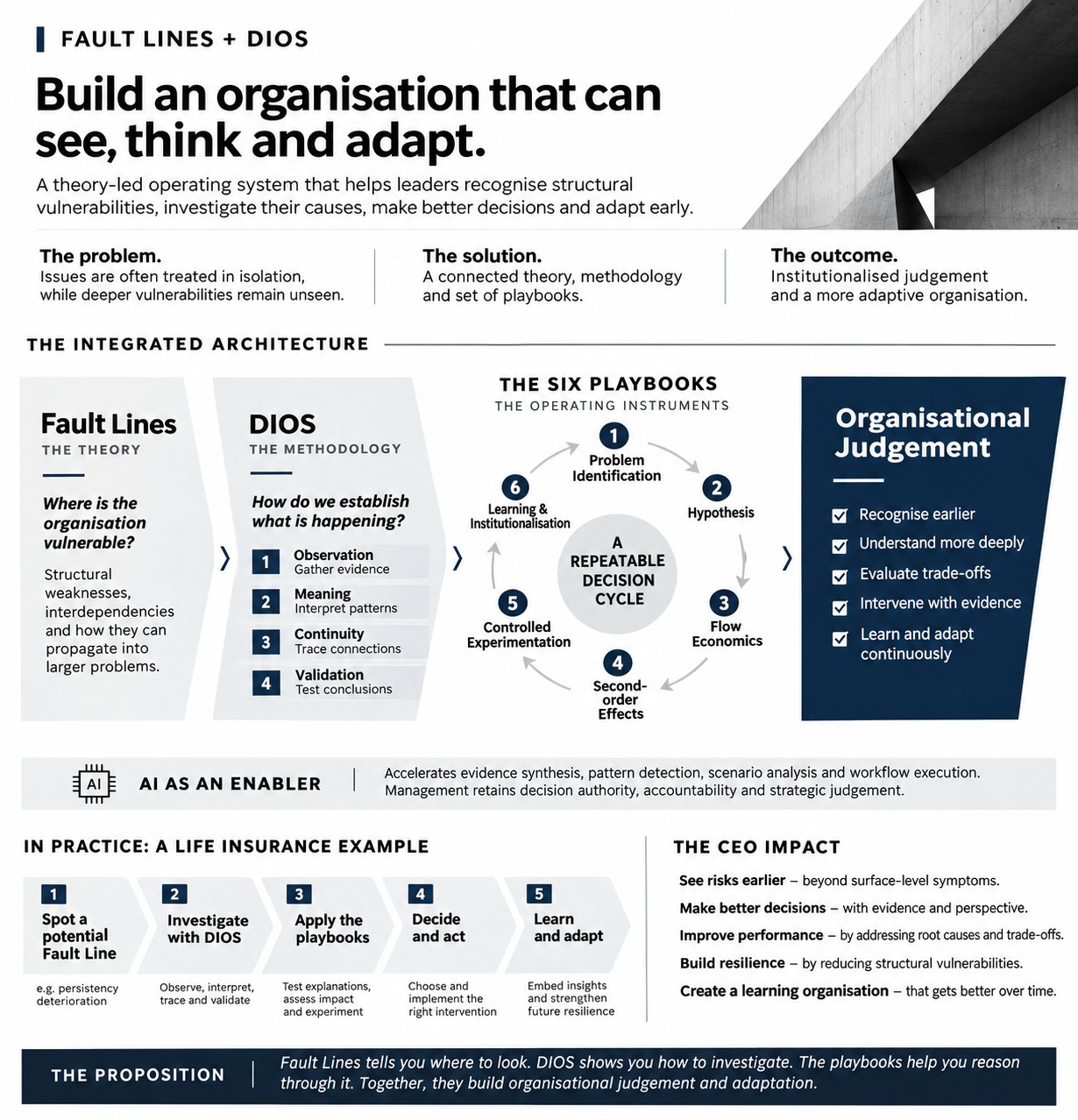
Enquire ↗Fault Lines reveals structural vulnerability. DIOS establishes what is happening. Integrated playbooks bring discipline to the decisions that follow.
Recognition → Investigation → Reasoned action
A recurring workaround can look like a successful outcome. A business may be growing while its underlying operating system becomes more fragile. Fault Lines asks leaders to look beneath the dashboard.
Consider a digital journey routinely rescued by human intervention. Completion numbers tell you how many got through, but not where customers struggled or why assistance was necessary. Investigation—not assumption—distinguishes a design issue from a process or system failure.
The value is in the connection: a theory of vulnerability, a disciplined investigation system, and practical decision instruments. Not three disconnected products.
Where is the organisation vulnerable? Recognise structural tensions, interdependencies, buffers and conditions through which pressure can compound.
Defines where to look.How do we know what is happening? A four-layer system that links observation to defensible interpretation and validation.
The playbooks are operating instruments within DIOS—not a separate service line. Each addresses a particular reasoning task and can be selected according to the management question.
Bound the management question, affected population and evidence gaps.
Core instrumentMake explanations testable and identify evidence that can discriminate between them.
Core instrumentTrace how work, information and decisions influence economic value.
Core instrumentExamine how interventions redistribute work, cost, risk and behaviour.
In developmentTest interventions proportionately under actual operating conditions.
In developmentTurn validated learning into review routines and sustained adaptation.
Planned capabilityDevelopment status is shown explicitly. The three core instruments are Problem Identification, Hypothesis Creation and Flow Economics.
“The objective is not merely to collect more information. It is to develop an organisation that can recognise earlier, investigate better, and act with greater judgement.”
Choose an entry point that fits the management question—from leadership orientation to a focused diagnostic and ongoing senior advisory.
Introduce the Fault Lines lens and its application to live organisational questions.
Enquire ↗Develop a common language for recognising tension, fragility and adaptation.
Enquire ↗Investigate structural tensions and produce a prioritised Fault Line Map.
Enquire ↗Make intervention choices, clarify trade-offs and define accountability.
Enquire ↗Provide senior support on a consequential structural challenge.
Enquire ↗Our Digital Advisory practice addresses strategy, readiness, transformation and value realisation. Fault Lines + DIOS can deepen the investigation when hidden operating mechanisms demand it.
Explore Digital Advisory ↗